| Hypertext and Hypermedia. | Monday, 4 August 2014 | leave me ♥? |
Hypertext.
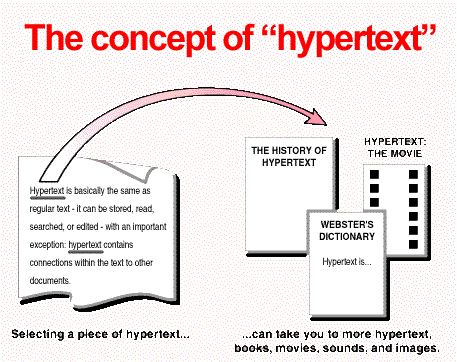
Hypertext is text displayed on a computer display or other electronic devices with references (hyperlinks) to other text which the reader can immediately access, or where text can be revealed progressively at multiple levels of detail (also calledStretchText). The hypertext pages are interconnected by hyperlinks, typically activated by a mouse click, keypress sequence or by touching the screen. Apart from text, hypertext is sometimes used to describe tables, images and other presentationalcontent forms with hyperlinks. Hypertext is the underlying concept defining the structure of the World Wide Web,[1] with pages often written in the Hypertext Markup Language (aka HTML). It enables an easy-to-use and flexible connection and sharing of information over the Internet.
Note how hypertext is not just flat text with highlights or paragraphs omitted during display, but rather, the text is hyper-structured with hyperlinks or other structures embedded inside a page, including hidden search words, to control the display and connection with other pages or hypertext nodes.
Types and uses of hypertext.
Hypertext documents can either be static (prepared and stored in advance) or dynamic (continually changing in response to user input, such as dynamic web pages). Static hypertext can be used to cross-reference collections of data in documents,software applications, or books on CDs. A well-constructed system can also incorporate other user-interface conventions, such as menus and command lines. Links used in a hypertext document usually replace the current piece of hypertext with the destination document. A less known and used feature is StretchText, which expands or contracts the content in place giving more control to the reader in determining the level of detail of the displayed document. Hypertext can develop very complex and dynamic systems of linking and cross-referencing. The most famous implementation of hypertext is the World Wide Web, first deployed in 1992.
Forms of hypertext.
There are various forms of hypertext, each of which are structured differently. Below are four of the existing forms of hypertext:
axial hypertexts are the most simple in structure. They are situated along an axis in a linear style. These hypertexts have a straight path from beginning to end and are fairly easy for the reader to follow. An example of an axial hypertext is The Virtual Disappearance of Miriam.
arborescent hypertexts are more complex than the axial form. They have a branching structure which resembles a tree. These hypertexts have one beginning but many possible endings. The ending that the reader finishes on depends on their decisions whilst reading the text. This is much like gamebook novels that allow readers to choose their own ending.
networked hypertexts are more complex still than the two previous forms of hypertext. They consist of an interconnected system of nodes with no dominant axis of orientation. Unlike the arborescent form, networked hypertexts do not have any designated beginning or any designated endings. An example of a networked hypertext is Shelley Jackson's Patchwork Girl.
layered hypertext consist of two layers of linked pages. Each layer is doubly linked sequentially and a page in the top layer is doubly linked with a corresponding page in the bottom layer. The top layer contains plain text, the bottom multimedia layer provides photo's, sounds and video. In the Dutch historical novel 'De man met de hoed' designed as layered hypertext in 2006 by Eisjen Schaaf, Pauline van de Ven en Paul Vitányi, the structure is proposed to enhance the atmosphere of the time, to enrich the text with research and family archive material and to enable readers to insert memories of their own.
Hypermedia
Hypermedia, an extension of the term hypertext, is a nonlinear medium of information which includes graphics, audio, video, plain text and hyperlinks. This contrasts with the broader term multimedia, which may include non-interactive linear presentations as well as hypermedia. It is also related to the field of electronic literature. The term was first used in a 1965 article by Ted Nelson.
The World Wide Web is a classic example of hypermedia, whereas a non-interactive cinema presentation is an example of standard multimedia due to the absence of hyperlinks.
The first hypermedia work was, arguably, the Aspen Movie Map. Bill Atkinson's HyperCard popularized hypermedia writing, while a variety of literary hypertext and hypertext works, fiction and nonfiction, demonstrated the promise of links. Most modern hypermedia is delivered via electronic pages from a variety of systems including media players, web browsers, and stand-alone applications (i. e., software that does not require network access). Audio hypermedia is emerging with voice command devices and voice browsing.
.jpg)
Example of hypermedia.
 Hello , welcome to my personal blog. My name is Pipie and I am born in 09 December 1994 , I am from Malaysia. I don't express my feeling well. Can be quite shy too ^▵^ I have a very Hot-temper and i rely on my friends alot. Who hate to do homework and like to eat. I'm slow, so do be patient with me.If you want to know more about me , you can tag me on my tagboard or add me up on my website , the website are above just click it . I am a student in Kolej Yayasan Sabah and will be graduating soon . My ambition is to become a lecturer .
I draw, but not very good to say.
I like taking photos but most of my pictures are nonsense , I like to take everything . My mum always scold me because I can't take picture nicely and I love fashion so much but sadly I am not the fashionable type . I wish I can open a boutique .
I have a big passion for web-designing.
Sometimes i think i'm not good enough.
I don't have alot of things to say,
I listen and nod.
Hello , welcome to my personal blog. My name is Pipie and I am born in 09 December 1994 , I am from Malaysia. I don't express my feeling well. Can be quite shy too ^▵^ I have a very Hot-temper and i rely on my friends alot. Who hate to do homework and like to eat. I'm slow, so do be patient with me.If you want to know more about me , you can tag me on my tagboard or add me up on my website , the website are above just click it . I am a student in Kolej Yayasan Sabah and will be graduating soon . My ambition is to become a lecturer .
I draw, but not very good to say.
I like taking photos but most of my pictures are nonsense , I like to take everything . My mum always scold me because I can't take picture nicely and I love fashion so much but sadly I am not the fashionable type . I wish I can open a boutique .
I have a big passion for web-designing.
Sometimes i think i'm not good enough.
I don't have alot of things to say,
I listen and nod.